How ChainSafe works: sign, share, verify
ChainSafe brings three moves together in one product: you sign a compliance declaration once, you share it with whoever asks for proof, and every recipient checks it without an account. Underneath, the platform keeps the full foreign-worker dossier and logs every action. This page explains how each step works — for anyone who has to prove that an entire chain is exercising due diligence.
Sign
A guided three-step wizard takes you from a blank page to a signed compliance declaration:
- Choose your document language — Dutch, French or English. The document and the matching share email are drafted in that language.
- Use the lawyer-reviewed default text or your own text. You see the exact document you are signing — no hidden template.
- Sign with two confirmations: that the content is correct and that you are authorised to sign.
Once signed, the compliance declaration is immutable — enforced down to the database level, not just on screen. The person who drafts the document need not be the one who signs it: fine-grained permissions separate drafter from signer.
From the signed declaration, ChainSafe generates a PDF on your own letterhead, with the verification link and QR code built in.
Share
Sharing works in two ways:
- Directly to your partner’s VAT number on the platform.
- By email as a PDF on your letterhead, with a branded, localized accompanying message — also to partners who do not (yet) work on ChainSafe.
Share to a VAT number and more happens than a send. The company is validated against the official registries (VAT/CBE), the partner and the partnership are created automatically in your chain, and if your partner is not yet on ChainSafe, an invitation goes out immediately.
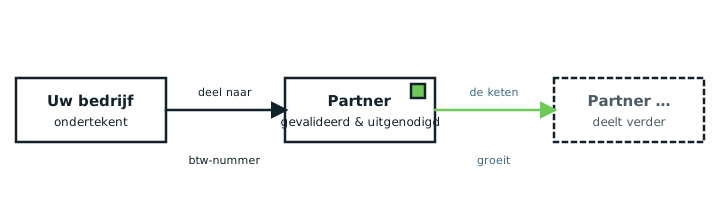
That way your verified chain grows with every shared compliance declaration — no re-keying, no Excel list of attestations. If a client asks you for proof, that same invitation brings you onto the platform too; our team helps you get started.
Verify
Every signed compliance declaration carries a public verification link and a QR code in the PDF. Whoever receives it — client, main contractor or inspector — checks it in one click and without an account. The verdicts are unambiguous: valid, expired, not signed or not found.
Paper can be forged. The verification page cannot. Read more about what each verdict means on the Verification page.
The dossier behind it
A compliance declaration does not stand alone. ChainSafe keeps the underlying dossier, so you can actually demonstrate your diligence:
- The foreign-worker dossier — per worker: identity, Limosa or a documented exemption, A1 with validity dates, Dimona, permits, right of residence, and the foreign employer’s details. Kept in a guided wizard, stored encrypted with per-organisation keys.
- The organisation compliance profile — your own company’s compliance status, ready to share.
- The partner and company directory — your whole chain in one overview, every partner validated against the official registries.
The audit trail
Every action on a compliance declaration is logged visibly: created, signed, shared, exported, archived — each with a timestamp and actor. That way you show not only the end result, but the path to it. Demonstrate — do not merely claim.
Read on
The full explanation of the legislation itself — the duty of care, who is at risk, which documents to request — lives on ketenaansprakelijkheid.be.
Not sure whether chain liability applies to you? Take the free self-test or schedule a call.